- +91 97676 52349
- vitthalpilescenter@gmail.com
- Opening Hours: 24 Hours
Home → I Feel Burning After Bowel Movement – Is This Fissure or Piles?
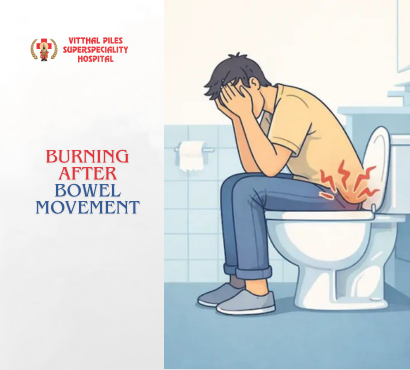
“Doctor, I feel a burning sensation after passing stool. Is it fissure or piles?”
This is a very common concern, but the answer is not always as simple as choosing between the two. Burning around the anus after a bowel movement can occur with an anal fissure or piles, but the pattern of symptoms can be quite different. Constipation, frequent loose stools, irritation of the skin around the anus, and several other anorectal conditions can also cause discomfort.
The timing of the pain can provide an important clue. A sharp or cutting pain during bowel movement followed by burning that continues for minutes or even hours is more suggestive of an anal fissure. Piles, on the other hand, may cause bleeding, itching, swelling, a lump, discomfort, or pain depending on whether they are internal or external. However, symptoms can overlap, and some people can have both conditions at the same time.
That is why repeatedly treating the symptom without understanding its cause may not solve the problem.
If you are experiencing burning after bowel movements, the first step is to understand what your symptoms may be telling you.
The anus contains highly sensitive tissue and a complex group of muscles. When this area becomes irritated, injured, swollen, or inflamed, bowel movements can become uncomfortable.
Burning may occur:
The exact sensation matters. A burning feeling that continues after bowel movement is particularly important because it can occur when an anal fissure causes irritation and muscle spasm in the anal canal.
However, symptoms alone cannot establish a diagnosis.
An anal fissure is a small tear or crack in the lining of the anus. Despite being small, it can be extremely uncomfortable because the area contains many sensitive nerve endings.
One of the most common triggers is passing hard or dry stool. Significant straining can put additional pressure on the delicate tissue and contribute to a tear.
A fissure can create a cycle that is difficult to break.
A person experiences pain while passing stool, becomes worried about the next bowel movement, starts avoiding the toilet, and then develops harder stool because of delayed bowel movements. The harder stool can irritate or reopen the fissure, leading to another painful episode.
This is one reason constipation management is an important part of fissure care.
Fissure pain is often described as:
The pain may continue for some time after passing stool because the internal anal muscle can go into spasm. This can make the discomfort feel much more intense than the size of the tear would suggest.
Bright red blood may also appear on toilet paper or on the surface of the stool.
Piles, medically known as hemorrhoids, are swollen and inflamed veins in and around the anus or lower rectum.
They are broadly classified as:
Internal hemorrhoids develop inside the anal canal and commonly cause painless bright red bleeding, although prolapsed internal hemorrhoids can become uncomfortable or painful.
External hemorrhoids develop beneath the skin around the anus. They may cause a tender lump, itching, swelling, or pain.
Piles can therefore cause burning, but burning alone does not automatically mean you have piles.
Knowing the typical pattern can help you understand why a clinical examination may be necessary.
These patterns are useful clues, but they are not a substitute for diagnosis. Rectal bleeding can have several causes, so it should not automatically be attributed to piles.
Constipation is an important factor in both piles and fissures.
When stools become hard, dry, or difficult to pass, people often strain more. Repeated straining increases pressure around the anal region and can aggravate existing hemorrhoids.
With a fissure, hard stool can stretch the anal opening and reopen the healing tear.
The result may be a repeating cycle:
Hard stool → straining → pain or injury → fear of bowel movement → delayed stool → harder stool
Breaking this cycle is often an important part of recovery.
Yes.
Burning after bowel movement is not exclusively associated with constipation. Frequent loose stools can repeatedly expose the sensitive skin around the anus to stool and digestive secretions. Frequent wiping can add further irritation.
People who have several bowel movements a day may therefore develop soreness and burning even without piles or fissures.
If loose stools persist, the underlying reason should also be assessed rather than treating only the skin irritation.
The way you use the toilet can influence anorectal symptoms.
Spending a long time sitting on the toilet, repeatedly straining, or delaying bowel movements can contribute to problems.
A healthier toilet routine includes:
These simple habits can reduce unnecessary pressure on the anal region.
A diet containing adequate fibre can help maintain softer and more regular stools.
Indian meals can naturally provide fibre through foods such as:
The goal is not simply to eat a large quantity of fibre suddenly. A gradual increase, combined with adequate fluid intake, is generally more comfortable for the digestive system.
If your diet is already high in fibre but constipation continues, there may be another contributing factor that needs attention.
Adequate fluid intake supports normal bowel function.
People who drink too little water may find that their stools become harder, particularly when combined with a low-fibre diet.
Hydration requirements vary depending on factors such as climate, activity level, diet, age, and medical conditions. Rather than following a rigid number, maintain regular fluid intake unless your doctor has advised you to restrict fluids.
Warm water can provide temporary relief from anal discomfort.
A warm sitz bath may help relax the area and soothe irritation, particularly after bowel movement. It should be comfortably warm rather than excessively hot.
Gentle cleaning is also important. Avoid aggressive rubbing, excessive wiping, or harsh soaps around the anus because these can increase irritation.
Not every episode of burning requires an urgent consultation. However, persistent, recurrent, or severe symptoms deserve professional assessment.
Consider consulting a doctor if:
Persistent anal pain accompanied by fever, pus, or constant throbbing pain may indicate an abscess or fistula rather than a simple fissure or hemorrhoid.
If you are looking for information about a fistula treatment hospital in Pune, you can learn more about the clinical services and care approach at
A common mistake is assuming that every instance of bleeding or burning is piles.
Piles are common, but they are not the only cause of anorectal symptoms. Anal fissures, infections, inflammatory bowel conditions, abscesses, fistulas, and other gastrointestinal problems can sometimes produce overlapping symptoms.
Rectal bleeding in particular should be assessed when it is unexplained, recurrent, heavy, or accompanied by other concerning symptoms.
A proper assessment allows the clinician to determine whether the problem is actually a fissure, hemorrhoid, or another condition.
A consultation usually begins with a detailed discussion of your symptoms.
The doctor may ask:
Depending on the symptoms, an examination of the anal region may be recommended.
The objective is not simply to identify the source of pain but to understand what is causing the problem and whether any underlying condition needs treatment.
You can consider consulting a proctologist in Pune if persistent anorectal symptoms are interfering with your daily life or recurring despite basic measures.
There is no single treatment for “burning after bowel movement.”
The appropriate approach depends on whether the cause is:
For uncomplicated fissures, improving stool consistency and avoiding repeated trauma may be sufficient in some cases. Persistent fissures may require prescription medication designed to relax the anal sphincter and promote healing. Some patients with chronic fissures may eventually require a procedure when conservative treatment is unsuccessful.
For hemorrhoids, treatment may range from dietary and toilet-habit changes to medicines, minimally invasive procedures, or surgery depending on severity and the type of hemorrhoid.
If you are specifically researching laser treatment for piles in Pune, it is important to understand that treatment should be selected after determining the type and severity of hemorrhoids rather than choosing a procedure based only on the technology used.
Two people can report “burning after passing stool” and require completely different treatment.
One person may have a simple fissure caused by hard stool. Another may have external hemorrhoids. Someone else may have persistent skin irritation from frequent loose motions. A fourth person may have a more significant anorectal condition.
This is why the focus should be on diagnosis first and treatment second.
A procedure that is appropriate for one condition may not be appropriate for another.
Small changes can make a meaningful difference in preventing repeated irritation.
Include adequate fibre and fluids in your daily routine.
If the stool is not passing easily, repeatedly pushing harder is unlikely to be helpful.
Ignoring the urge repeatedly can contribute to harder stools.
Avoid prolonged sitting on the toilet, particularly when there is no active bowel movement.
Excessive wiping and harsh products can irritate sensitive skin.
Regular movement can support healthy bowel function.
If constipation keeps returning, do not simply continue taking temporary remedies without understanding why it is happening.
Many people try an anal cream as soon as they experience burning or itching.
Some products may temporarily relieve symptoms associated with hemorrhoids, but using a product without knowing the cause can delay appropriate treatment.
For example, a persistent fissure may require a treatment strategy aimed at reducing anal muscle spasm and supporting healing rather than simply applying a soothing cream.
Similarly, ongoing bleeding should not be repeatedly masked with topical treatment without evaluation.
If symptoms continue, professional advice is more appropriate than repeatedly changing products.
No.
Occasional mild irritation can happen, particularly after constipation, diarrhoea, or repeated wiping. But recurrent burning after almost every bowel movement should not simply be accepted as normal.
Persistent symptoms may indicate that the underlying problem has not resolved.
This is particularly important when pain lasts for a long time after bowel movement, bleeding repeatedly occurs, or symptoms are progressively worsening.
It is possible to have both conditions.
For example, prolonged constipation may cause a fissure while repeated straining contributes to hemorrhoids. In such situations, treating only one condition may leave the other unresolved.
A proper examination can distinguish between the conditions and help determine which problem requires priority.
Some symptoms should not be managed at home for an extended period.
Seek prompt medical evaluation if you experience:
Severe pain combined with bleeding or systemic symptoms requires medical assessment rather than assuming that it is ordinary piles.
Persistent anorectal problems can be uncomfortable to discuss, but delaying evaluation often makes people more anxious about the condition.
A doctor who routinely evaluates anorectal disorders can assess symptoms such as:
For patients specifically searching for a piles specialist in Pune, the priority should be a proper diagnosis and an appropriate treatment plan rather than choosing treatment based solely on advertisements or assumptions about the condition.
Burning after a bowel movement can be uncomfortable, frustrating, and sometimes worrying. An anal fissure is a common explanation when the burning is accompanied by sharp pain during stool passage and discomfort that continues afterward. Piles may produce bleeding, itching, swelling, lumps, or discomfort, but the symptoms can vary considerably depending on the type of hemorrhoid.
Constipation, diarrhoea, excessive wiping, and other anorectal conditions can also cause burning. This makes self-diagnosis unreliable, particularly when symptoms persist or recur.
The most useful first steps are to keep stools soft, maintain adequate fibre and fluid intake, avoid straining, limit prolonged toilet sitting, and maintain gentle hygiene. If symptoms continue, recur frequently, or are associated with bleeding, severe pain, swelling, fever, or discharge, professional evaluation is important.
Understanding the difference between fissure and piles is useful, but identifying the actual cause is even more important. With the right diagnosis and timely care, most anorectal conditions can be managed with an approach suited to the individual.
Burning that follows a sharp or cutting pain during bowel movement and continues afterward is commonly associated with an anal fissure. Piles may be associated with bright red bleeding, itching, swelling, or a lump. Because symptoms can overlap, an examination may be needed to determine the exact cause.
Yes. Hard stools and straining can irritate or tear the sensitive anal tissue, contributing to fissures. Constipation can also aggravate hemorrhoids. Improving stool consistency and avoiding excessive straining are important parts of prevention and recovery.
No. Piles are a common cause of bright red rectal bleeding, but fissures and other gastrointestinal or anorectal conditions can also cause bleeding. Recurrent, unexplained, heavy, or unusual bleeding should be evaluated rather than automatically attributed to piles.
Call us any time:
+91 97676 52349Email us 24/7 hours:
vitthalpilescenter@gmail.comOur Hospital Location:
Vitthal Piles Super Speciality Hospital
We are providing painless, without operation, day care, cost effective anorectal disease treatment since last 16 years & spreading smile over thousands of patients. The treatment we provide are advanced and of different modalities according to pathology.
Vitthal Piles Super Speciality Hospital, Darekar heights 2nd floor, Opposite of pandit petrol pump, Hinjewadi Road, Dange chowk, Pimpri-Chinchwad, Pune, Maharashtra 411033, India
+91 97676 52349
vitthalpilescenter@gmail.com
Opening hours : 24 hours OPD Timing – Morning : 11:30am – 2:30pm Evening : 5:30pm – 7pm
Copyright © 2023 All Rights Reserved.
Privacy Policy
Terms & Conditions